Executive summary
The creator economy is no longer a side bet. US advertisers now treat creators as a core media channel, social platforms take the largest single slice of digital ad revenue, and the biggest creators run consumer-goods companies with billion-dollar valuations. By almost any top-line measure, 2027 will be the biggest year yet.
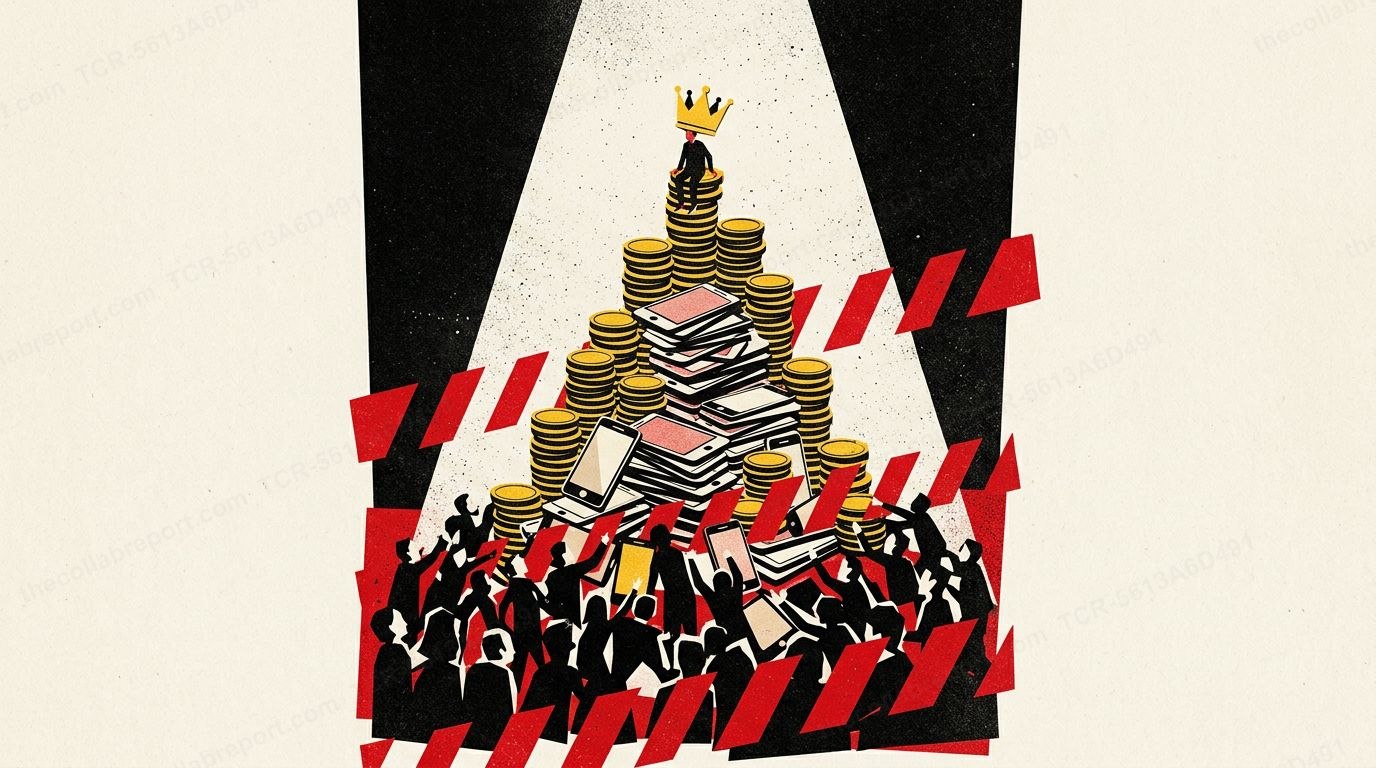
But the top line is hiding the story. The money is growing far faster than the number of people who can live on it. Our reading of the data supports three theses that we expect to be argued about well into next year:
- The creator middle class is a myth. The share of creators earning a professional income has barely moved in three years of surveys, even as spend roughly doubled. Growth is going to the top and to the intermediaries.
- Brands are overpaying for reach, and AI will reprice the bottom of the market. Pay still tracks follower count rather than engagement, and generative video is about to make commodity UGC a near-zero-cost input.
- Platforms are quietly moving away from paying creators directly. The direction of travel is from platform-funded payouts toward commerce commissions and brand money that platforms broker but don't pay out of their own pockets.
Five key findings
- US creator ad spend hit an estimated $37.1 billion in 2025 and is projected at $43.9 billion for 2026, per IAB, up from $13.9 billion in 2021. IAB put 2025 growth at 26%, roughly four times the 5.7% rate for media overall.
- Two-thirds of creators (67%) earn less than $10,000 a year from content, and only 4% earn more than $100,000, according to CreatorIQ's 2026 survey of 5,055 creators. Goldman Sachs reported the same 4% professional share in 2023.
- Brand deals are the economy's single point of failure. In a 2026 #paid survey, 81% of creators named brand deals as their main income source; just 3% said platform payouts.
- Concentration is extreme and rising. The top 10 companies took 84.1% of US digital ad revenue in 2025, according to the IAB/PwC annual report, which logged a 3.4% share gain for that group.
- Regulation of synthetic content has arrived. New York's synthetic-performer ad disclosure law took effect in June 2026, and the EU AI Act's Article 50 labelling duties applied from August 2, 2026.
The money: every measure says up, none agree on how much
Start with the most conservative, best-documented number: what US marketers spend on creators. IAB's 2025 Creator Economy Ad Spend & Strategy report estimates the figure climbed from $13.9 billion in 2021 to $18.4 billion in 2022, $22.1 billion in 2023 and $29.5 billion in 2024. It put 2025 at $37.1 billion and projected $43.9 billion for 2026. That is more than a tripling in five years.
The growth rate is the headline. IAB pegged 2025 creator spend growth at 26%, against 5.7% for the total US media industry, drawn from its own Outlook Study. Nearly half (48%) of ad buyers in the IAB study described creators as a must-buy, behind only social media and paid search. Nearly two-thirds of creator spend comes out of social budgets, which tells you creators are taking share inside social as well as from outside it.
Note one tell in the IAB series: its projected 2026 growth (about 18%) is slower than 2025's 26%. Creator spend is still compounding, but it is maturing. That matters for everything that follows. A market growing at a quarter a year can carry a lot of inefficiency. A market growing at a sixth starts asking about ROI, and IAB found that 40% of buyers already rank overall ROI as their top creator KPI.
The broader ad market supports the picture. The IAB/PwC Internet Advertising Revenue Report for full-year 2025, released in April 2026, put US digital ad revenue at a record $294.6 billion, up 13.9%. Social advertising reached $117.7 billion, up 32.6%, and became the largest single channel at 40% of the market, edging past search at $114.2 billion.
Globally, WPP Media's June 2025 This Year Next Year forecast estimated creator ad revenue at $185 billion for 2025 and projected it could reach $376 billion by 2030. Tubefilter's reading of the same report was that combined ad spend on creator-driven platforms would top $325 billion in 2025, more than TV, audio, print and film. WPP's midyear 2026 forecast put total global ad revenue at $1.3 trillion for 2026.
Then there is the number everyone quotes. In 2023, Goldman Sachs Research sized the creator economy at roughly $250 billion and forecast that it could approach $480 billion by 2027, with about 50 million creators worldwide. A 2025 Goldman update counted about 67 million creators and projected 107 million by 2030.
Our take: these numbers are not competing estimates of one thing. They measure different things. Goldman sized a total revenue pool; WPP counts ad revenue on platforms where creators post; IAB measures US marketer spend on creators specifically; eMarketer's narrower US influencer marketing line was $10.52 billion in 2025, per its March 2025 forecast. Anyone quoting "a half-trillion-dollar creator economy" next to "creators are broke" is not contradicting themselves. Both are true, and the gap between them is the story of this report.
The inequality problem: the middle class that never formed
Here is the thesis we expect to draw the most fire: the creator middle class is, statistically, a myth.
CreatorIQ's 2026 State of Creators survey, the firm's largest to date, found that 67% of creators earned under $10,000 a year from content creation and only 4% earned over $100,000. By subtraction, about 29% sit between those marks. For 62% of respondents, creating was not their primary source of income.
Now compare that with Goldman Sachs in 2023, which reported that about 4% of creators earned more than $100,000 and said it expected that share to hold steady as the ecosystem grew. Between 2023 and 2026, US creator ad spend rose from $22.1 billion to a projected $43.9 billion, per IAB. The professional share, on the best available measures, did not move.
Older data points the same way. Linktree's 2022 Creator Report, based on more than 9,500 creators, found only 12% of full-time creators earned over $50,000 a year, and most surveyed creators had never done a brand deal.
At the top, by contrast, the money is enormous. Forbes' 2025 Top Creators list found the top 50 earned a combined $853 million in the year to April 2025, with MrBeast first at $85 million. Fortune reported in February 2025 that his businesses brought in more than $400 million in 2024 sales, per people familiar with the matter, and were raising at about a $5 billion valuation.
Why doesn't more money mean more middle? Three mechanisms, in our view:
- Pay follows reach. CreatorIQ's 2026 findings indicate follower count still beats engagement rate as a pay driver, even though brands say they value engagement. Reach is a winner-take-most input.
- One revenue stream, controlled by buyers. In #paid's Creator Signals 2026 survey of US and Canadian creators, 81% cited brand deals as their primary income source, 8% affiliate, 3% platform payouts and 2% each physical and digital products. Goldman's 2023 estimate put brand deals at about 70% of creator revenue. When one buyer class sets nearly all prices, the creators with the most leverage capture the surplus.
- Supply grows faster than demand. If Goldman's count from roughly 50 million (2023) to 67 million (2025) creators is right, the denominator is growing about as fast as IAB's spend line.
The steelman. Defenders of the middle-class story make fair points. Surveys of "creators" include hobbyists who never intended to earn a living, so a 67% sub-$10,000 figure partly measures ambition, not failure. A part-time creator earning $8,000 on top of a salary may be a success. Income surveys also skew to the platforms and networks running them. And in absolute terms, 4% of 67 million creators would be well over two million people earning six figures, a meaningful profession. We accept all of that. But the claim that rising spend is lifting a broad professional middle is not supported by any dataset we found. The money is real; its distribution is a power law.
Platforms: concentration, commerce, and the quiet retreat from payouts
The creator economy runs on rented land, and the landlords are consolidating. The IAB/PwC report found the top 10 companies captured 84.1% of US digital ad revenue in 2025. WPP's midyear 2026 report noted that Meta, Alphabet, Amazon and Microsoft together reported over $150 billion in Q1 2026 ad revenue.
YouTube remains the one platform that pays creators at scale through a revenue share. At its Made on YouTube event in September 2025, CEO Neal Mohan said YouTube had paid more than $100 billion to creators, artists and media companies over four years, including $70 billion from 2021 to 2024. Alphabet disclosed in February 2026 that YouTube generated $60 billion in 2025 revenue across ads and subscriptions, with ad revenue of about $40.4 billion, per Tubefilter's analysis.
But look at what the newer platforms built. TikTok wound down its original Creator Fund in key markets in favor of its Creator Rewards program, and Meta halted Reels bonus payouts, according to trade coverage of both moves. The growth engine at TikTok is not ad share; it is commerce. Momentum Works estimated TikTok Shop's 2025 gross merchandise value at $64.3 billion across 16 markets, up 94%, including $15.1 billion in the US (up 68%) and $45.6 billion in Southeast Asia.
That brings us to our third thesis: platforms will quietly stop paying creators directly. Not overnight, and not YouTube first. But the incentives point one way. A creator paid in affiliate commission on a TikTok Shop sale is funded by the merchant. A creator paid through a platform's brand-deal marketplace is funded by the advertiser. A creator paid from a platform bonus pool is funded by the platform. Every platform would rather be the broker than the payer, and commerce lets them be.
The steelman. YouTube's $100 billion is the strongest counterevidence: revenue share has been a durable moat, and competitors that cut payouts risk losing talent. Direct payouts also give platforms quality control, as YouTube showed when it tightened monetization rules on mass-produced, inauthentic content from July 15, 2025. We think YouTube keeps its model. Our forecast is that new money elsewhere arrives as commission and brokered brand spend, not as platform-funded pools.
Brands: the reach premium is a bubble in slow motion
IAB's buyer data reveals the contradiction at the heart of creator marketing. The top campaign goals were brand awareness (43%) and reaching new audiences (41%), with online sales and conversions at 32%. Yet the top KPI for 40% of buyers is ROI. Brands are buying reach and grading on return.
Execution is still immature. About a third of brands told IAB that finding the right creators was their biggest hurdle. Around three in four use flat fees for direct partnerships, versus 49% for performance-based deals. Flat fees indexed to follower counts are precisely how you overpay for reach.
Holding companies have read the signal. Publicis acquired Influential in 2024 in a deal widely reported at $500 million, and CreatorIQ said in December 2025 that its customers increased creator payments 79% year over year. The investment is flowing into infrastructure and intermediaries, while US venture funding for creator-focused startups fell 51% in a year, according to The Information as cited by eMarketer. Capital is betting on the pipes, not on the long tail of creators.
Our second thesis, part one: brands are overpaying for reach. As spend growth slows toward IAB's projected 18% and ROI pressure rises, we expect a shift from flat fees to performance and hybrid deals, compressing mid-tier rates that are priced on audience size.
The steelman. Reach is not worthless; brand awareness is a legitimate objective, and creator content often outperforms traditional ads on attention and trust. Mid-tier creators (50,000 to 500,000 followers) had the highest brand adoption in IAB's study at 61%, which suggests buyers are already discriminating rather than blindly chasing the biggest accounts. Fair. But adoption is not price discipline.
AI: the floor is about to fall out of commodity UGC
Every buyer survey shows AI moving from novelty to workflow. IAB found nearly three in four creator ad buyers were using or planned to use AI within a year, mostly for content editing (49%), creator briefs (46%) and personalization (45%). Influencer Marketing Hub's 2026 benchmark found creator discovery was the leading AI use, at about 37% of selections, with content generation at about 21%.
At the same time, 95% of advertisers in the IAB study had concerns about AI in creator marketing, led by the loss of human connection. That concern is the creator's best defense, and it applies unevenly.
Our second thesis, part two: AI will crash the price of commodity user-generated content. A large share of creator work is not personality-led; it is scripted product demos, testimonials and unboxings commissioned for paid amplification. Generative avatar and video tools now sell this format on subscription. Where the buyer wants a face holding a product and not a specific person, a synthetic performer will win on cost and turnaround.
The irony is that AI should raise the value of the top. When synthetic content is cheap and plentiful, the scarce asset is a real person with a real audience that trusts them. Expect a sharper split: authentic, audience-owning creators gain pricing power; faceless and templated UGC suppliers lose it.
The steelman. Regulation and platform policy may protect human creators: disclosure rules (below) make synthetic ads visibly synthetic, which could depress their performance, and YouTube's inauthentic-content policy shows platforms will police slop. Consumer backlash is real. We think these limit AI at the top of the market and in organic feeds, but do little to stop brands using synthetic UGC in paid social, where the disclosure is a label, not a ban.
Regulation: disclosure becomes the cost of doing business
2026 was the year synthetic-content rules stopped being proposals.
- New York. Governor Kathy Hochul signed a law in December 2025 requiring advertisers to disclose synthetic performers, digitally created humans not recognizable as real people, when they know one is used. It took effect June 9, 2026, with penalties of $1,000 for a first violation and $5,000 for each subsequent one, according to Cooley's analysis.
- European Union. The AI Act's Article 50 transparency obligations applied from August 2, 2026, requiring deployers to visibly label deepfakes. The Commission published a final, voluntary Code of Practice on marking and labelling AI content on June 10, 2026, per Jones Day.
- US federal. The FTC's rule banning fake reviews and testimonials, including AI-generated ones, took effect in October 2024 and carries civil penalties, per law-firm analyses.
- Child creators. California's SB 764, signed by Governor Gavin Newsom in 2024, requires that at least 15% of earnings from content featuring minors be set aside in trust where minors appear in over 30% of a creator's content, per Campaign.
The direction is clear: synthetic content is legal but must be labelled, and family content is legal but must be accounted for. Compliance becomes a fixed cost, which favors larger agencies and creator businesses over solo operators. That is concentration again.
10 predictions for 2027
These are Data Desk forecasts, not reported facts. Each is grounded in the trends cited above.
- US creator ad spend tops $50 billion in 2027. IAB projects $43.9 billion for 2026; even if growth slows to the mid-teens from IAB's projected 18%, the line crosses $50 billion.
- Growth decelerates for a third straight year below 2024's 34% pace. Maturity, not collapse.
- The 4% professional share stays flat. Any 2027 income survey with comparable methodology will again show roughly one in 25 creators clearing $100,000.
- Performance-based deals gain on flat fees. We expect the IAB's share of brands using performance pricing (49% in 2025) to rise as ROI pressure builds.
- Mid-tier UGC rates fall. Synthetic-avatar video takes a visible share of paid-social testimonial and demo work; prices for templated UGC fall first.
- No major new platform launches a creator payout fund. New monetization announcements are commerce, affiliate and brokered brand deals.
- TikTok Shop's US GMV grows again, building on 68% growth in 2025, keeping commerce the fastest-growing creator income line.
- At least one more US state passes a synthetic-performer ad disclosure law modelled on New York's.
- More holding-company and platform M&A in creator infrastructure, following Publicis-Influential, while venture funding for creator-tools startups stays depressed.
- Another creator-led consumer brand raises at a valuation above $1 billion. The MrBeast model, where products out-earn content, becomes the template for top-tier creators.
What it means
For creators. Treat brand deals as income and audience ownership as equity. The data say platform payouts are a rounding error for most (3% primary-income share in the #paid survey) and brand deals are concentrated risk. Build direct channels (email, community, products) and lean into what AI cannot fake: a recognizable voice and a trusted relationship. If your work is templated UGC, plan for price compression now.
For brands. Stop paying for followers and start paying for outcomes. Move a growing share of creator spend to performance and hybrid contracts, measure engagement and conversion rather than reach, and budget for disclosure compliance in New York, the EU and anywhere synthetic performers appear. Use AI for briefs, discovery and versioning; keep human creators where trust matters.
For agencies and platforms. The intermediary layer is where the money is consolidating, which makes it the next target for scrutiny. Agencies that can prove ROI and manage compliance will win budgets; those reselling reach will be undercut by AI and self-serve marketplaces. Platforms should expect pressure, from creators and possibly regulators, over how commerce and brokered deals replace direct pay.
Methodology note
This report synthesizes publicly available research published between 2022 and October 2026. Primary sources include IAB's 2025 Creator Economy Ad Spend & Strategy Report; the IAB/PwC Internet Advertising Revenue Report (full year 2025); Goldman Sachs Research (2023 and 2025); WPP Media's This Year Next Year forecasts (June 2025, June 2026); eMarketer (March 2025); CreatorIQ's 2026 State of Creators survey (5,055 creators, fielded May to June 2026, reported by Net Influencer); #paid's Creator Signals 2026 (reported by Net Influencer); Linktree's 2022 Creator Report; Influencer Marketing Hub's 2026 benchmark; Momentum Works' TikTok Shop data (February 2026, via ContentGrip); Alphabet and YouTube disclosures; Forbes and Fortune; and legal analyses from Cooley, Jones Day and Campaign.
Market-size figures are not comparable across sources: they differ in scope (global vs US), what is counted (total revenue, ad revenue, or marketer spend) and method. Survey data are self-reported, often drawn from vendors' own networks, and skew toward US respondents. Where we derived a figure, such as the 29% middle income band (100 minus 67 minus 4), we say so. IAB's 2025 and 2026 values are estimates and projections. All predictions are Data Desk forecasts, labelled as such.